


In recent years, as medical technology continues to advance, thestem cell transplantIt has gradually come into the public's view. It is not only a high-end medical treatment that can rebuild the hematopoietic and immune systems, but also a key hope for many patients with leukemia, lymphoma, aplastic anemia and other serious diseases to regain their lives.
However, for those who are considering transplantation, "hope" is often accompanied by "worry".Is stem cell transplantation safe? Are there any serious side effects during the treatment? Are there any long-term after-effects after success?Some have even compared it to a "big gamble" where success or failure is at stake.
This article will take youA comprehensive understanding of whether stem cell transplantation is really safe and its real risks and possible after-effects, and to share the physician's clinical summary ofKey prevention pointsWe help you find a more scientific and reassuring balance between hope and risk.
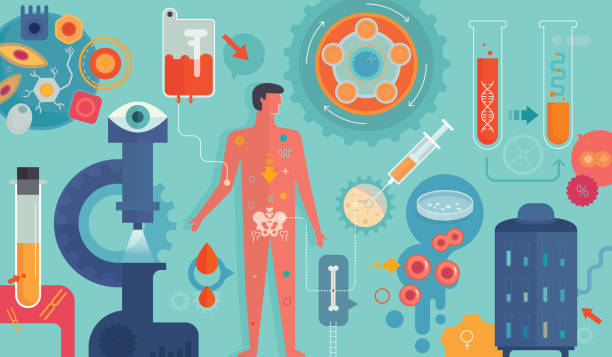
Is stem cell transplantation safe? Are there any risks and after-effects? Doctors will give you a detailed explanation of the real risks and precautionary points.
I. The essence of stem cell transplantation: "systems engineering" for rebuilding life
Stem cell transplantation is simply the process of transplanting healthy blood stem cells into a patient's body so that they can re-establish the blood and immune systems. This process acts as a "reboot" of the body's defense mechanisms and restores the body's ability to produce healthy blood cells.
Depending on the source of stem cells, transplants can be divided into two categories:
-
autologous transplant: Using the patient's own stem cells;
-
allograft: from a healthy donor (e.g., a relative or volunteer donor).
Before the transplant, doctors will remove the abnormal hematopoietic system in the body through radiotherapy and other means to "make room" for new stem cells. The entire process goes through layers of evaluation and preparation, from donor matching, immune tolerance to pre-operative testing, all of which are extremely stringent.
Today, stem cell transplants are standardized, processed and closely monitored - they are performed in sterile laminar flow wards and monitored by a dedicated team throughout the process to ensure that every step meets international safety standards.
Second, why are stem cell transplants risky?
No medical treatment can be completely "risk-free", and the challenges of stem cell transplantation includeThe process of rebuilding the immune systemThe
In order for the new stem cells to "settle" successfully, doctors will remove the old system through pretreatment (radiotherapy). During this phase, the patient's immune system is temporarily weakened, making him or her susceptible to infections, bleeding and other threats. Therefore, stem cell transplantation needs to be carried out under close supervision, and doctors will take protective measures in advance, such as anti-infection treatment and nutritional support, to ensure that the critical period is passed safely.
This is why stem cell transplantation is not "just a shot" but a delicate "systemic treatment of the whole body".
III. Modern Medicine Makes Stem Cell Transplantation Safer
The safety of stem cell transplantation has taken a quantum leap in the last 20 years. The continuous optimization of medical treatments and supporting measures has allowed many risks to be effectively controlled.
According to data from the Chinese HSCT registry, 18,165 HSCTs will be completed in 2022 alone.In 2025, the number of HSCTs in the50 Years of Hematopoietic Stem Cell Transplantation - China's Solution Reshaping the WorldThe review literature of "The Evolution of Domestic Transplant Centers from the Early Years to the Present, Standardized Management, and Safety Improvement" also talks about the evolution of domestic transplant centers from the early days to the present day, standardized management, and safety improvement.[1]
-
Pretreatment programs are gentler: Today's "low-intensity" or "precision-dose" regimens can reduce the damage caused by radiotherapy.
-
More rigorous infection prevention and control: The use of antibiotics, antiviral medications, and air purification systems has resulted in a significant reduction in the risk of infection.
-
Strict donor screening: All donor stem cells are subject to HLA high-resolution matching, virus testing and ethical approval to ensure source safety.
-
Better monitoring system: The whole process of transplantation is under real-time monitoring, and the doctor dynamically adjusts the program according to the indicators.
Thanks to these advances, today the survival rate of autologous stem cell transplantation generally exceeds 90% and that of allogeneic transplantation reaches 70%-80%. A large number of patients recover well after surgery and return to normal work and life.
IV. Common risks and sequelae: transient and manageable
Doctors categorize the main risks of stem cell transplants as follows:
Most post-transplant discomfort isControllable, transient, such as mild fever, mouth ulcers, malaise and loss of appetite. These symptoms are mostly related to the rebuilding of the immune system and are part of the body's natural phase of recovery.
Doctors usually take targeted treatment measures such as:
-
Nutrition and electrolyte replacement;
-
Adjustment of immunosuppressive drugs;
-
Anti-inflammatory and anti-infective supportive therapy.
Symptoms typically resolve within a few weeks to months as immune function gradually recovers, leaving no noticeable after-effects.
V. Is stem cell transplantation safe? Through long-term real clinical data: verify itssafety
On October 25, 2024, thenaturallyIn a journal report, a research paper titled "Do Stem Cell Transplants Increase Cancer Risk? Longevity Recipients Reveal Clues," reveals important findings by tracking stem cell transplant cases from 50 years ago.[2]
The study, conducted by Japanese clinical researcher Masumi Ueda Oshima's team, followed long-surviving patients and their donors who underwent hematopoietic stem cell transplants in the late 1960s. A total of 32 participants (16 donor-recipient pairs) had their blood samples collected and were analyzed for mutations associated with bone marrow cancers using high-precision sequencing technology.
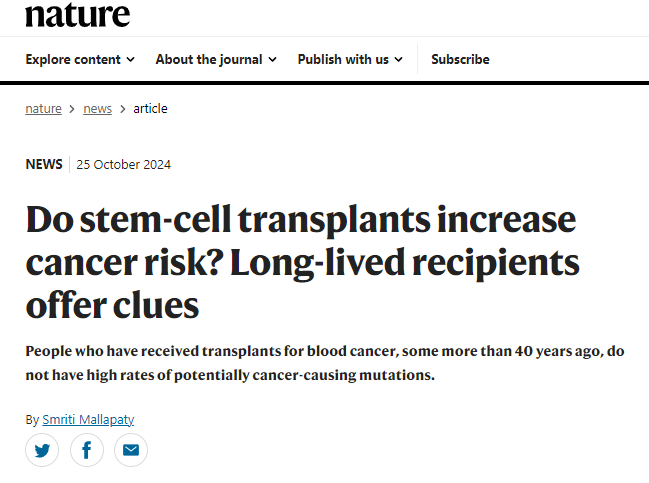
The results showed that while a very low percentage of naturally mutated cells (about one in a million) were present in the blood of all donors, the mutation rate in the recipients was almost identical to that of the donors many years after transplantation - the average annual mutation rate was only 2.61 TP3T vs. 21 TP3T. study leader Spencer Chapman said: "Surprisingly, the stem cells produced few new mutations during transplantation."
Further genome-wide analysis revealed that the overall genetic changes in the recipient cells were only equivalent to normal aging of about 1.5 years.Suggests that transplantation does not significantly increase cancer or genetic risk. In other words.Stem cells are able to maintain a stable genetic structure and function in the human body for a long period of time, and will not "go out of control" or cause abnormal proliferation.
The significance of this study is that it confirms for the first time, through real-life cases spanning nearly half a century, that stem cell transplantationLong-term safety and genetic stabilityThis is why millions of stem cell transplant patients worldwide have been able to survive and regain a healthy life. Because of this, millions of stem cell transplant patients worldwide have been able to survive long term and regain a healthy life, and are further proof that stem cell therapy is an Safe, reliable, time-tested treatmentsThe
VI. Doctors' recommendations: scientific assessment, safety first
Although stem cell transplants are generally safe, they are not suitable for everyone. Therefore:
1. Before transplantation: adequate assessment and preparation
-
Rigorous screening of patients: Comprehensive assessment of age, organ function, comorbidities
-
refinement of donor's choice: Selection of HLA high-resolution allozyme donors wherever possible
-
Full informed consent: Ensure that patients and families understand all potential risks
2. In transplantation: delicate handling and close monitoring
-
Standardized cell handling: Ensuring stem cell quality and viability
-
Individualized pre-processing: Adaptation of program intensity to the patient's situation
-
Real-time monitoring: Closely monitor vital signs and indicators
3. Post-transplantation: systematic management and long-term follow-up
-
Scientific immunosuppression: Balancing GVHD prevention and immune reconstitution
-
Active infection control:: Includes environmental management and drug prevention
-
Comprehensive supportive treatment: Nutritional support, symptom management
-
Regular rehabilitation assessments: Includes physical functioning and quality of life
concluding remarks
Stem cell transplantation is not an "adventure", but a proven treatment that has been around for decades. It has changed the fate of many patients with severe hematologic diseases, making a "cure" no longer just a hope.
For patients, the most important thing is not to be afraid of the risk, but to understand the risk scientifically, choose the regular channels and follow the doctor's advice. With the continuous progress of medicine, stem cell transplantation is gradually changing from a "high-risk treatment" to a "controllable and predictable" life project.
When science and trust go hand in hand, stem cell transplantation is no longer a "last resort", but a robust path to recovery that can be safely traveled by more people.
References:
[1] Huang, Xiao-jun. Hematopoietic stem cell transplantation 50 years: from pioneering to leading, the Chinese protocol has reshaped the global landscape]. Chinese protocol has reshaped the global landscape]. Zhonghua Xue Ye Xue Za Zhi. 2025 Jun;46(6):489-93. Chinese. doi: 10.3760/cma.j.cn121090-20250509-00221. PMCID: PMC12337230.
[2] https://www.nature.com/articles/d41586-024-03450-x
Disclaimer: This article is intended only to disseminate scientific knowledge and share industry perspectives, and does not constitute any clinical diagnostic advice! The information published by Hangi Stem Cells is not a substitute for the professional advice of a physician or pharmacist. If you have any questions about copyright or other issues, please feel free to contact me.
郑重声明:本文版权归原作者所有,转载文章仅为传播更多信息之目的,如作者信息标记有错误,请第一时间联系我们修改或删除,多谢。

Leave a Reply